
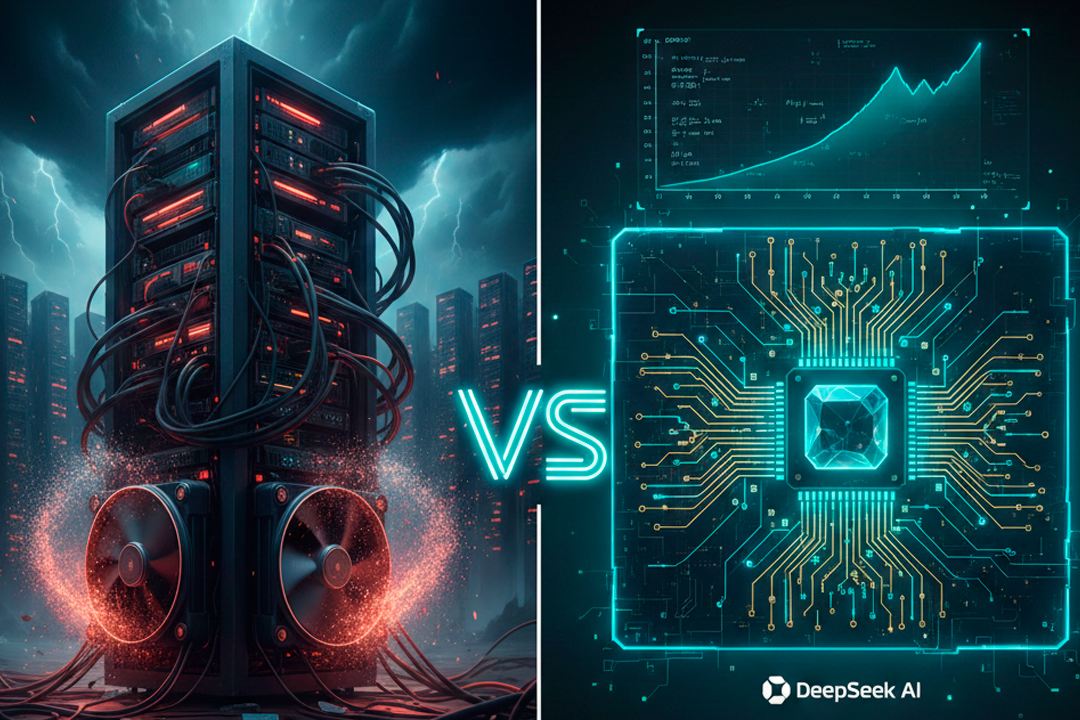
While the Western world is obsessed with how much compute they can throw at a problem, DeepSeek AI is quietly proving that clever engineering beats brute force every single time. As a systems architect, I’ve stopped looking at “marketing benchmarks” and started looking at their paper on Multi-head Latent Attention (MLA).
Is DeepSeek just a budget alternative to GPT-4, or have they actually solved the efficiency puzzle that Silicon Valley is still struggling with? Let’s dive into the guts of DeepSeek V3 and the reality of their “clever architecture.”
1. Sparse Attention: The End of Compute Waste?
DeepSeek’s headline claim is their “New Sparse Attention Design,” which allegedly cuts costs to under 3 cents per 1M tokens. This isn’t just a price war; it’s a structural shift. By using sparse attention, the model only activates relevant parameters for a given query.
The Architect’s Reality Check: Sparse models often suffer from “knowledge gaps” or inconsistent reasoning under load. While the token efficiency is impressive, I’m watching the latency curves closely. If the system takes 2 seconds to decide which sparse path to take, the cost savings are negated by a poor user experience. Currently, their throughput during peak hours suggests they still have some scaling “technical friction” to iron out.
2. Conditional Memory: Addressing “Silent LLM Waste”
One of the most interesting claims is their “conditional memory” system. Most LLMs waste massive GPU cycles on static lookups—data that doesn’t change but gets re-processed constantly. DeepSeek claims to have optimized this.
This is a potentially brilliant move for Agentic Workflows where long-term context is key. However, managing this memory overhead without introducing new bottlenecks is a high-wire act. Poorly managed memory leads to technical debt that eventually breaks the model’s coherence in long conversations.
3. DeepSeek Attention (DSA) and the Long-Context War
Processing long sequences is the Achilles’ heel of modern AI. DeepSeek’s DSA claims to reduce inference costs by half for long contexts. If true, this makes DeepSeek the prime candidate for large-scale document analysis and codebase auditing.
“It’s not about how big your context window is; it’s about how much it costs you to look at the whole window at once.”
4. Open Source and the Security Paradigm
DeepSeek has gained massive traction by going open-source. While this invites community scrutiny, it also demands rigorous code audits. For enterprise-grade stability, an open-source model is a double-edged sword: you get transparency, but you also inherit the responsibility of securing the implementation yourself.
The Bottom Line: Show Me the Numbers
DeepSeek is the most serious challenge to the “brute force” scaling laws we’ve seen this year. Their focus on architectural nuance over raw GPU count is exactly what the industry needs to move past the current plateau.
Verdict: I’m cautiously optimistic. If they can maintain these prices without sacrificing reasoning depth, OpenAI has a serious problem on their hands. But until we see independent, third-party benchmarks on Reasoning-per-Watt, I’m keeping my production keys in a safe place.
What’s your take? Is DeepSeek’s efficiency enough to make you switch from GPT-4? Let’s talk architecture in the comments.